
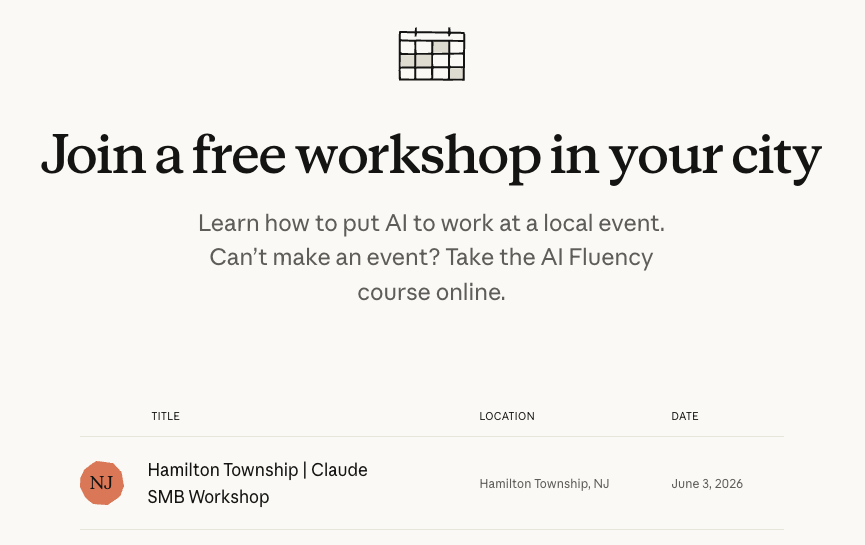
Anthropic's Claude SMB Tour will visit Chicago, Tulsa, Dallas, Hamilton Township New Jersey, Baton Rouge, Birmingham, Salt Lake City, Baltimore, San Jose, and Indianapolis this spring. New York City is not on the list.
The closest stop to NYC is Hamilton Township NJ, which is over an hour south on a good traffic day. For Manhattan, Brooklyn, Queens, Bronx, and Staten Island SMB leaders, that means no half-day Anthropic AI fluency workshop in the five boroughs this season. Anthropic has indicated more cities will be added in the fall, and I expect NYC to make that list given the city's economic profile. But for now, the tour skipped New York.
That is not a complaint. It is a fact. And it is a fact you can do something about. The half-day Anthropic workshop format is not magic. The agenda is published. The training material exists. The free on-demand course is online. You can run the same playbook for your own team starting Monday. This post tells you how.
What the Workshop Actually Covers
Anthropic and Tenex.co built the workshop around a tight structure. AI fluency training, then hands-on practice, then peer conversation. Each section serves a specific purpose, and you can replicate each one inside your own firm.
Block 1: AI Concepts (75 minutes)
What AI is genuinely good at, what it is not, and how to think about deploying it in a real business. Most of the public version of this content is in Anthropic's free AI Fluency for Small Business course on Skilljar, developed in partnership with PayPal and launched alongside Claude for Small Business on May 13, 2026. The course is on-demand, free, and takes about 54 minutes across nine lessons.
Action: Assign the free course to your management team and your most senior operator. Make it a one-week assignment with a deadline. Reconvene to discuss it.
Block 2: Hands-on (120 minutes)
Attendees work through guided exercises using Claude against their own business data. The bar Anthropic set: walk out with at least one workflow you can run the next morning.
Action: Identify three workflows in your business that fit the profile (high frequency, moderate judgment, clear inputs and outputs). Examples: weekly cash and AR reporting, invoice chase against AR aging, monthly close prep, contract review for vendor agreements, content drafts for marketing review. Pick one. Spend two hours with your team running it against a recent month of real data. Document what worked and what broke.
Block 3: Peer conversation (60 minutes)
The most underrated part of the workshop is the room. SMB leaders sharing what worked, what failed, and what they are nervous about. Hard to replicate solo, but there are options.
Action: Invite three or four peer operators from non-competing businesses to a working dinner. Share what you tried, what failed, what is genuinely useful. The conversations are different from anything you will get from a vendor.
Note: Tour attendees also receive a free one-month Claude Max subscription to begin integrating AI into their day-to-day workflows. This is a benefit worth replicating by securing trial access for your team before your internal workshop.
The NYC Compliance Overlay
New York has more AI-relevant regulations than any other state in the country. If you run an SMB in the five boroughs (or anywhere in New York State for that matter), four legal frameworks apply that operators in Texas or Oklahoma do not contend with at the same density.
NY SHIELD Act
The Stop Hacks and Improve Electronic Data Security Act applies to any business that owns or licenses computerized data including private information of a New York resident. That is most SMBs in New York. SHIELD requires reasonable safeguards on private information, including reasonable administrative, technical, and physical safeguards.
Practical impact on AI deployment: When you connect an AI tool to systems holding NY resident private information, your safeguards analysis must include the AI vendor. Standard vendor risk assessment. Standard contractual data protection terms. Standard incident response procedures. Document the assessment.
NY DFS Part 500
If your business is in financial services and regulated by the New York Department of Financial Services (insurance companies, banks, mortgage lenders, virtual currency businesses, others), Part 500 cybersecurity regulations apply. The rule was substantially amended in November 2023, with compliance deadlines phased through November 1, 2025.
Part 500 imposes specific requirements on third-party service provider security, multi-factor authentication, encryption, incident reporting (72-hour notification), and senior officer attestation. An AI vendor handling regulated data falls under these requirements.
If you are a DFS-regulated SMB, do not deploy any AI tool without going through your existing Part 500 vendor risk assessment process. Period.
NYC Local Law 144 (Automated Employment Decision Tools)
Enacted in 2021 and in effect since January 1, 2023, NYC Local Law 144 regulates Automated Employment Decision Tools (AEDTs). If you use AI to "substantially assist or replace discretionary decision-making" in hiring or promotion for positions in NYC, you have specific obligations: bias audits performed by independent auditors, notice to candidates, and public disclosure of audit results on your company website.
Practical impact: if your AI workflows touch resume screening, candidate ranking, or promotion recommendations, talk to employment counsel before deploying. The penalty structure is not catastrophic per violation (up to $1,500 per subsequent violation) but compliance failures are visible — the audit results are public.
NY Attorney General AI guidance
The NY AG has been active on AI in consumer-facing contexts, issuing guidance on deceptive AI practices, AI-generated marketing content, and AI in financial product targeting. For consumer-facing SMBs (retail, hospitality, financial services, healthcare), the AG framework adds another layer to evaluate AI content against deceptive trade practice rules.
Three Pilot Workflows for NYC SMBs This Month
If I were running an SMB in Manhattan or Brooklyn and wanted to get started in June, here is the sequence.
AR chase against your aging report. Lowest regulatory risk, highest immediate ROI. Use whatever AI tool you choose. Run it against your last 60 days of AR. Measure how much time it saves and how many overdue invoices got responses.
Weekly business pulse. Pull cash, sales, pipeline, and commitments into a one-page weekly view. Replaces the spreadsheet most owners build manually on Sundays.
Vendor contract review against your standard playbook. Especially useful for NYC firms with high contract volume from real estate, professional services, and marketing relationships.
Measuring Whether Your Internal Workshop Actually Worked
The mistake most SMBs make with internal AI fluency efforts is treating it as a one-time training event. The right model is a 90-day deployment with metrics.
Three metrics worth tracking from day one.
Hours saved per workflow per week (across the team using it).
Time-to-action on overdue items (AR days outstanding, contract review turnaround, others).
Adoption rate. What percent of your team is using AI on at least one regular workflow within 30 days? Within 60? Within 90?
If your adoption rate is under 30 percent at the 60-day mark, you have a workflow problem, not a technology problem. The workflows you chose are not the right starting points.
Closing Thought
The Claude SMB Tour skipped NYC this spring. That is annoying, but New York has the deepest density of operators, regulators, capital, and AI talent of any city in the country. The disadvantage of missing a half-day workshop is small compared to the resources NYC SMBs have at hand to learn this stuff themselves.
Start with the free course this week. Pick a workflow. Run it against real data. Then run the next one. By the time the fall tour stops are announced, your team will be three months ahead of any room you might walk into anyway. Have questions? We have an entire team running our Managed AI services. Let's chat.
Interested in this topic? Continue reading with Blog #7 in our Claude SMB Series.
Disclosure: Techvera is an MSP serving small and medium businesses across North Texas (Denton headquarters), Oklahoma (Tulsa), and New York, including financial services firms in our customer base. Our internal operations are powered in part by Anthropic's Claude. Nothing in this post constitutes legal, compliance, or investment advice. The regulatory landscape for AI in financial services is evolving rapidly. Consult counsel and your compliance officer for specific guidance.
About the Author
Todd Mitchell
Chief Operating Officer
Todd Mitchell is the COO of Techvera, bringing operational expertise and strategic vision to help businesses transform their IT infrastructure.