43.3% of US dentists now use AI for at least one task, and another 26.4% plan to adopt it, according to the ADA Health Policy Institute's mid-2026 practice panel. Imaging and diagnostics leads current use at 22.8%. Charting and note-taking leads planned adoption at 34.8%.
Retention is the harder number. In a survey of 300 dentists across the US, Canada, and the UK, 40% abandoned their AI tool within three months, citing cost and poor practice management software integration. The subscription renews on schedule either way.
That gap is almost always a measurement failure. The tool went live without a baseline, so nobody could say what changed, so nobody could defend the line item. This is a framework for avoiding that.
Charting AI and Imaging AI Do Not Share a Business Case
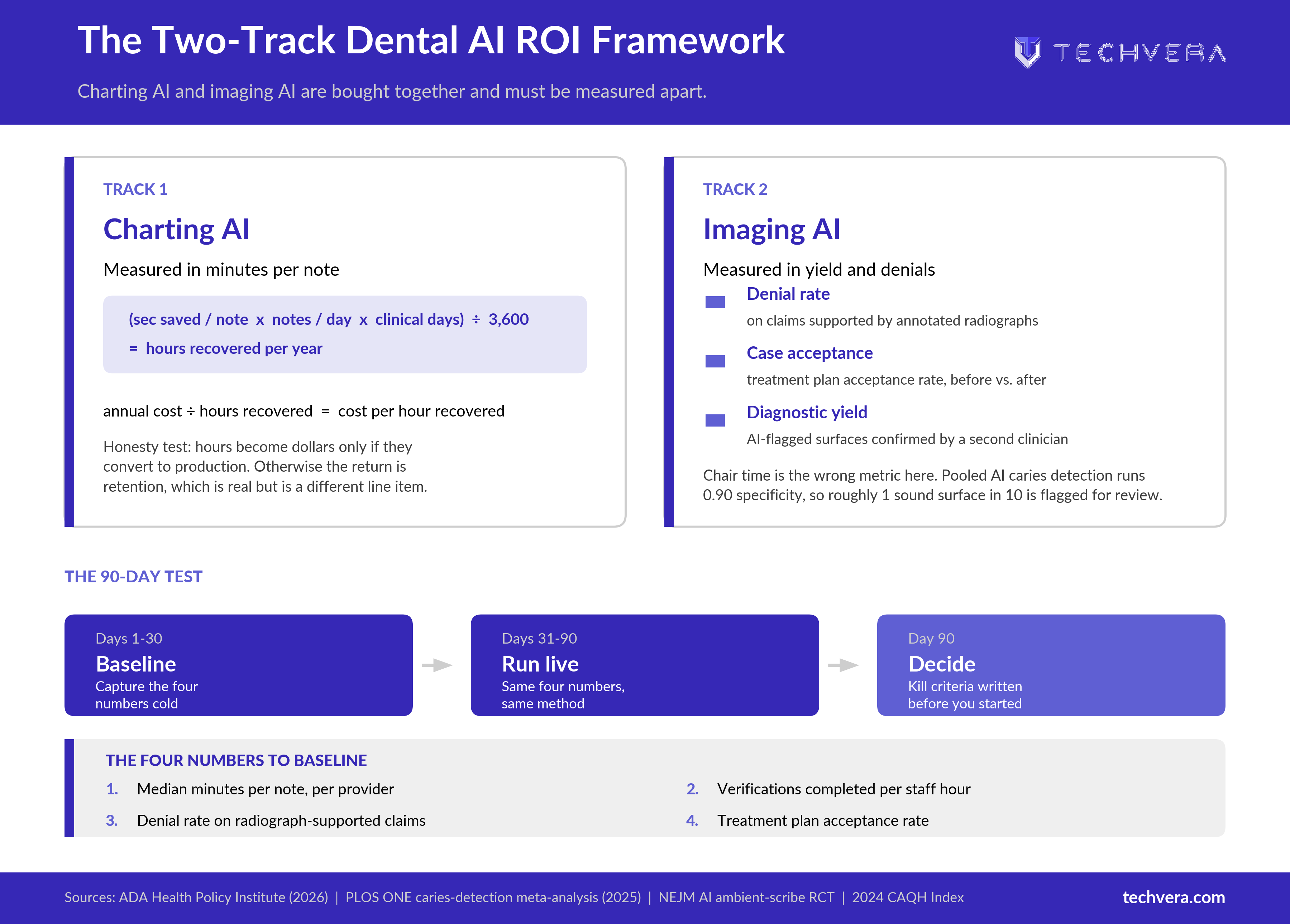
They land in the same budget line and get judged by the same question, which is where the analysis goes wrong. Charting AI sells recovered minutes. Imaging AI sells diagnostic yield and better-documented claims. One formula cannot measure both, and averaging them produces a number that describes neither. Run the two tracks separately.
Track One: Charting AI Is Measured in Minutes Per Note
The strongest evidence available is medical rather than dental, so treat it as a ceiling and not a promise. A randomized trial of 238 physicians across 14 specialties and roughly 72,000 patient encounters, published in NEJM AI and led by researchers at UCLA Health, found the stronger of two ambient AI scribes cut time per note by 41 seconds, from 4:30 to 3:49. That is a 9.5% reduction against the control group. The second tool saved 18 seconds and missed statistical significance entirely.
Forty-one seconds per note only compounds into something if your note volume is high enough. Here’s the math
(seconds saved per note × notes per day × clinical days per year) ÷ 3,600 = hours recovered per year
annual subscription cost ÷ hours recovered = your cost per recovered hour
At 25 notes a day across 220 clinical days, 41 seconds per note returns about 62 hours a year. Divide your annual cost by 62 and you have a number you can actually argue about.
Then apply the honesty test. Hours become dollars only if they convert into something. If documentation moved out of the 7 pm kitchen-table session and back into the operatory, the return shows up in retention and provider capacity, not in monthly production. Both matter. They are not the same line on a P&L, and reporting them as one is how practices talk themselves into renewals.
One more cost the trial surfaced: AI-generated notes occasionally contained clinically significant inaccuracies, most often omissions. Clinician review time is not overhead you get to skip. Build it into the model.
Track Two: Imaging AI Is Measured in Yield and Denials
A 2025 umbrella review with meta-analysis in PLOS ONE put pooled AI performance for caries detection at 0.85 sensitivity and 0.90 specificity, with an area under the curve of 0.86. The authors concluded that clinical use is justified, and that AI should not substitute for human judgment.
Read that specificity figure as a workflow cost rather than a report card. Roughly one sound surface in ten gets flagged. Across a full-mouth series that is a real pile of findings to dismiss, and dismissing them requires a clinician, not a coordinator.
So imaging ROI is not chair time. Track three things instead:
1. Denial rate on claims supported by annotated radiographs, measured before and after rollout.
2. Treatment plan acceptance. 44% of AI users in the Oral Health Group survey reported improvement, which is self-reported and worth checking against your own ledger before you believe it.
3. Diagnostic yield. Restorations placed on AI-flagged surfaces that a second clinician independently confirmed.
Worth remembering that 82.6% of dentists in the ADA HPI panel do not plan to use AI for treatment recommendations at all. The tool is a second reader. Price it as a second reader.
The Highest-Return Dental AI Is Also the Least Interesting
Zentist's 2026 Dental RCM Trends & Insights Report, built on responses from more than 160 billing professionals, found 58% of the market adopting AI for verification and payment posting. That is the unglamorous end of the stack, and it has the cleanest economics of anything in this post.
The 2024 CAQH Index prices dental eligibility and benefit verification at $9.72 per manual transaction, $4.41 through a payer portal, and $2.55 fully electronic, with eight minutes of staff time recoverable per transaction. Claim status inquiries run $15.21 manual against $3.73 electronic. Dental staff told CAQH that phone inquiries were the single most time-consuming administrative task measured, at 18 minutes each.
Move 300 monthly verifications from manual to fully electronic and that is roughly $2,150 a month plus 40 hours of staff time. At the BLS May 2024 median of $22.74 an hour for dental assistants, those hours carry a defensible price. For scale, ADA News reported that dental eligibility and benefit verification spending rose 15% to $2.1 billion in 2023, with $580 million in savings available from going fully electronic.
If your imaging AI return is ambiguous and your verification workflow is still on hold music, you know which one to fix first.
The Costs That Don’t Show Up as a Line Item on the Invoice
Four line items practice owners find after signing.
Business associate agreements. Any vendor touching PHI is a business associate, and HHS has stated plainly that cloud providers storing PHI are covered even when the data is encrypted and the vendor cannot read it. No signed BAA means the exposure sits with you. We broke down the terms a workable agreement has to contain in BAAs and Vendor Risk: The Healthcare MSP's Obligations, and worked through the same question for general-purpose AI assistants in our HIPAA-grounded read on using Claude inside a healthcare practice.
Bandwidth and endpoints. Imaging AI uploads full-mouth series to a cloud model and waits for a response. A practice running on the connection it installed for email will feel that in the operatory, and so will the front desk.
Integration. Cost and practice management software compatibility were the two leading barriers in the Oral Health Group survey. A tool that will not write back into Dentrix, Eaglesoft, or Open Dental creates a second system of record, which is how a practice ends up paying for AI and then paying someone to retype its output.
FDA clearance. Imaging AI marketed for pathology detection generally requires 510(k) clearance. You can confirm any specific product in FDA's releasable 510(k) database in about two minutes. A product page is not a clearance letter.
Your cyber insurance carrier will also have opinions about new vendors with access to patient records, which is worth reading before renewal rather than during a claim. We covered what underwriters are asking dental practices in What Dental Practices Need to Know Before Renewing Cyber Insurance in 2026.
Run a 90-Day Test
Baseline for 30 days before the tool goes live. Four numbers:
Median minutes per note, per provider
Verifications completed per staff hour
Denial rate on claims supported by radiographs
Treatment plan acceptance rate
Run 60 days live and compare the same four. Write the kill criteria down before you start, because the common failure mode is a tool nobody ever measured, renewing on schedule while everyone assumes someone else checked. By day 90 you should be able to decide.
Where Techvera Fits
Techvera evaluates and deploys AI inside regulated environments through AI Solutions, and handles BAA review, access controls, and audit trails through Compliance Readiness. Because imaging AI widens the data path between your operatory and someone else's cloud, our Cybersecurity team scopes network segmentation and endpoint coverage as part of the same project instead of a follow-up ticket. Dental practices are already a preferred target for reasons we laid out in Why Dental Practices Are the #1 Target for Modern Cybercriminals.
To run this framework against your own numbers, schedule a consultation.
Frequently Asked Questions
How long does it take for AI charting or imaging to show a return in a dental practice?
Plan on 90 days to get a defensible answer, split into a 30-day baseline and 60 days of live use. Verification and payment posting automation tends to show measurable savings fastest because the per-transaction cost difference is already documented. The 2024 CAQH Index prices dental eligibility verification at $9.72 manual versus $2.55 fully electronic. Charting and imaging returns take longer to isolate because they depend on whether recovered clinician time converts into production or into reduced after-hours work.
Does a dental AI vendor need a business associate agreement?
Yes, if it creates, receives, maintains, or transmits protected health information on your behalf. HHS guidance is explicit that cloud service providers storing PHI are business associates even when the data is encrypted and the provider has no key. That covers most imaging AI, ambient charting tools, and automated eligibility verification. Get the signed BAA before the tool touches a patient record, not after.
How accurate is AI at detecting caries on radiographs?
A 2025 umbrella review with meta-analysis in PLOS ONE reported pooled sensitivity of 0.85 and specificity of 0.90, with an area under the curve of 0.86. The authors judged clinical use justified while stating that AI should not replace clinician judgment. A specificity of 0.90 means roughly one in ten sound surfaces gets flagged, so plan for clinician review time on every flagged finding.
Which type of dental AI delivers the fastest payback?
Administrative automation, specifically eligibility and benefit verification and claim status inquiries. The cost gap between manual and fully electronic transactions is already measured, the volume is predictable, and no clinical judgment sits in the loop. Zentist's 2026 Dental RCM report found 58% of the market moving on verification and payment posting for that reason.
Why do so many dental practices stop using AI within a few months?
40% of dentists surveyed across the US, Canada, and the UK dropped their AI tool inside three months, with cost and poor practice management software integration cited most often. Both are diagnosable before purchase. Confirm the tool writes results back into Dentrix, Eaglesoft, or Open Dental, and set a measurable success threshold before the trial starts so the renewal decision has evidence behind it.
About the Author
Team Techvera
Techvera Team
Articles written collaboratively by the Techvera team, combining expertise across cybersecurity, managed services, and digital transformation.