
Most RIA principals can tell you what they pay for portfolio management software. Far fewer can tell you what they spent last year on incident response readiness, vendor oversight documentation, or annual penetration testing. The gap between those two things is where SEC examination findings live.
The 2024 amendments to Regulation S-P, which require large RIAs (over $1.5B AUM) to comply as of December 2025 and smaller firms by June 3, 2026, fundamentally changed the cost calculus for running a defensible technology environment. Combined with the SEC's 2026 Examination Priorities, which specifically call out cybersecurity governance, vendor oversight, and preparedness for AI-driven intrusions, the compliance bar is higher than it has ever been.
This post breaks down the full cost picture of a compliant RIA technology stack in 2026, category by category, including the line items most firms leave off their annual budgets entirely. If you are newer to how SEC requirements differ across firm types, see our earlier write-up on broker-dealer vs. RIA IT compliance requirements.
The Core Software Layer
This is the category most RIAs budget for accurately. The problem is that it represents less than half of what a fully compliant environment costs to run.
Core annual software costs for a 10-to-15-person RIA typically include:
Portfolio management and performance reporting (Orion, Tamarac, Black Diamond): $8,000–$25,000/year
CRM (Wealthbox, Redtail, Salesforce Financial Services Cloud): $2,400–$18,000/year
Financial planning software (eMoney, MoneyGuidePro, RightCapital): $2,400–$9,600/year
Compliance platform (RIA in a Box, COMPLY, Orion Compliance): $6,000–$20,000/year
According to the 2025 Kitces Research on Advisor Technology, the typical independent advisor spends 4 to 6 percent of annual revenue on technology, with all-in spend falling between $20,000 and $40,000 per advisor per year. For a 10-person firm, the software bill alone runs $200,000 to $400,000 annually.
That number feels significant. It is. But it covers only the software layer.
The Security Controls Layer
This is where most RIA technology budgets begin to fall short.
Amended Regulation S-P requires RIAs to maintain written incident response programs, oversee service providers that handle customer information, and notify affected clients within 30 days of a qualifying breach. The SEC's 2026 Examination Priorities confirm that examiners will look for evidence of actual security controls in place: monitoring, logging, access controls, encryption, MFA, and incident response testing. Passing an exam on documentation alone is not realistic.
Managed IT and Managed Detection and Response (MDR)
Standard managed IT services for general small businesses run $150 to $250 per user per month. Financial services firms operating under SEC oversight need a higher tier that includes endpoint detection and response (EDR), SIEM logging, 24/7 monitoring, and quarterly security reviews. That tier runs $200 to $400 per user per month for financial sector environments. For a 10-person RIA, budget $24,000 to $48,000 per year for this layer alone.
Firms that use a provider with dedicated financial services expertise, such as Techvera's Cybersecurity services, build examination-ready documentation into the service delivery model rather than producing it under pressure before an exam.
Annual penetration testing and vulnerability assessment
The SEC expects firms to have conducted cybersecurity risk assessments as part of a defensible compliance posture. Annual penetration testing for a small-to-mid-size RIA environment runs $10,000 to $25,000. Many firms conduct this once during an initial compliance build and never revisit it. That is a gap examiners flag consistently.
Identity and access controls
MFA, email threat protection, privileged access management, and endpoint security tools together run $2,000 to $8,000 per year for a 10-person firm. These controls are also underwriting requirements for cyber insurance and are increasingly expected in custodian agreements.
Total for the security controls layer: $36,000 to $81,000 per year for a 10-person firm.
Vendor Oversight and Third-Party Risk Management
The 2024 Regulation S-P amendments created explicit third-party risk management requirements. RIAs must now maintain documented vendor oversight programs, ensure service provider contracts include 72-hour breach notification provisions, and conduct ongoing due diligence on every vendor that accesses client data.
The most common SEC examination finding in this area is not a poor choice of vendor. It is the absence of documented, ongoing oversight. That means the cost is not just an initial vendor audit. It is a sustained operational process.
What a defensible vendor oversight program costs annually:
Annual SOC 2 review per key vendor (internal or consultant time): 2 to 4 hours per vendor. For a typical RIA with 8 to 12 material vendors, budget 16 to 48 hours of consulting time per year.
Contract remediation to add Reg S-P breach notification language: a one-time cost of $3,000 to $8,000 using outside counsel, with ongoing internal time to manage renewals and new vendor onboarding.
Vendor risk register maintenance and annual review: if managed externally through a virtual CISO or compliance consultant, $5,000 to $15,000 per year. Techvera's vCIO Services anchor this function for firms that lack the internal resources to manage it continuously.
Total vendor oversight layer: $8,000 to $23,000 per year.
Incident Response Readiness
Regulation S-P requires a written incident response program. The 2026 Examination Priorities confirm that examiners will review whether firms have tested their procedures, not just documented them. Two budget lines that most RIAs skip entirely:
Incident response retainer
An incident response (IR) retainer is a pre-negotiated agreement with a cybersecurity firm that guarantees access to expert assistance during an active breach, with defined response time commitments and preferred rates. For financial services firms, retainers typically run $15,000 to $40,000 per year. Without one, a firm dealing with a live breach scrambles for help at emergency rates while the 30-day client notification clock runs. That combination produces both significant financial exposure and examination findings.
Cyber liability insurance
SEC rules do not currently mandate cyber insurance, but it has effectively become required by custodians, broker-dealers, and institutional counterparties. Most RIAs managing $100 million to $1 billion in AUM pay $4,000 to $8,000 per year for comprehensive coverage. Insurers now conduct detailed security control reviews at underwriting. Firms without documented controls face higher premiums, restricted coverage, or outright denial. Techvera's Cyber Insurance Advantage program helps financial services firms build the control environment that unlocks better coverage at more favorable premiums.
Total incident response readiness layer: $19,000 to $48,000 per year.
Examiner-Ready Documentation
The annual compliance review required under SEC Rule 206(4)-7 is not a passive policy check. Examiners expect evidence that the firm tested its written procedures against actual practices, reviewed transaction records, validated supervisory controls, and documented findings. A compliance consultant who reviews the policy binder once a year and calls it done is not sufficient.
Annual compliance review
Independent compliance consultants charge $150 to $300 per hour. A thorough annual review, including a cybersecurity program assessment, requires 20 to 40 hours. Budget $3,000 to $12,000 per year for a focused engagement. Firms without a dedicated CCO that rely on outside support for ongoing day-to-day oversight will spend $15,000 to $50,000 per year.
Written program development and maintenance
A compliant documentation suite covering a written information security program (WISP), incident response plan, business continuity plan, and vendor management policy costs $5,000 to $15,000 to develop and $2,000 to $5,000 per year to maintain and update. Techvera's Compliance Readiness service builds and maintains this documentation infrastructure for financial services firms as part of an integrated managed service, keeping it connected to how the technology environment actually operates.
Total documentation and compliance layer: $10,000 to $67,000 per year.
Where Firms Leave the Most Gaps
The most common failure pattern in RIA technology budgeting is not ignorance of these cost categories. It is compartmentalization. The principal approves the compliance platform. The office manager renews the Microsoft 365 tenant. An IT vendor manages workstations. No single function owns the integrated security and compliance stack, and that accountability gap shows up in examinations.
The specific failure points that create both examination risk and unnecessary spend:
Paying for a compliance platform but leaving no one responsible for keeping its documentation current and connected to actual firm practices.
Maintaining cyber insurance but no IR retainer, making it functionally impossible to meet the 30-day Regulation S-P notification requirement during an active breach.
Running vendor risk assessments inconsistently, or not at all, for vendors added since the last exam cycle.
No penetration test on record. The SEC will ask for it.
Business continuity documentation that exists on paper but has never been tested. See Techvera's Business Continuity and DR program for how financial services firms operationalize this requirement.
These are not obscure findings. They appear regularly in SEC deficiency letters. Firms operating on the managed IT platform Techvera builds for financial services clients have a single point of accountability across all five layers above. That does not eliminate the costs. It eliminates the gaps between them.
The Full Cost Picture
The table below summarizes annual cost ranges for each layer of a compliant RIA technology stack, based on a 10-person firm as the reference point. Your actual spend will vary with AUM, headcount, and whether you are building these capabilities from scratch or integrating with an existing infrastructure.
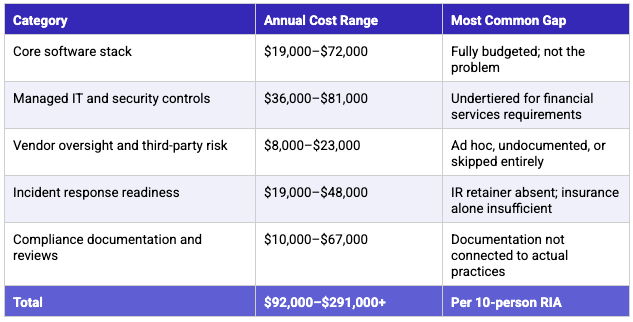
The range is wide because firm size matters. A 3-person RIA managing $200 million operates on different budgetary math than a 25-person firm managing $2 billion. What does not vary is the regulatory expectation. The SEC applies the same substantive compliance standards regardless of firm size. The question is not whether these costs are real. It is whether they are being planned for.
One Conversation Changes the Math
Firms that consolidate managed IT, cybersecurity, compliance documentation support, and vCIO oversight under a single provider typically spend 15 to 30 percent less than firms that source each category independently, because the duplicate work and accountability gaps disappear. More importantly, they enter SEC examinations with documentation that reflects how the technology actually operates, not how a standalone consultant assumed it did.
If your technology budget does not account for every category above, the right first step is a gap assessment. The Techvera Team can help to map current spend against actual compliance posture and build a plan that closes the gaps without unnecessary overhead.
Schedule a strategy session. It takes 30 minutes and costs nothing.
About the Author
Team Techvera
Techvera Team
Articles written collaboratively by the Techvera team, combining expertise across cybersecurity, managed services, and digital transformation.