
No family office principal has ever leaned across the dinner table and asked, "Tell me more about our intrusion detection system." They ask about their kids, their advisors, their next trip, and occasionally whether the household staff can be trusted with a spare key. Cybersecurity, as far as most principals are concerned, is somebody else's job. That is the problem, and it is also the opening for anyone advising a family office on technology.
Cybersecurity Expectations vs. Reality
A survey of global family offices by AlTi Tiedemann Global and Campden Wealth found that nearly 70% now rank cybersecurity as their top operational risk, ahead of market volatility and succession planning. Six in ten said they had already experienced at least one cyberattack, most often phishing, followed by data breaches, malware, and identity theft.
The same family offices that call cybersecurity their top risk also report feeling confident they can prevent an attack, with confidence levels running as high as the high 80s depending on the threat type. That is the cybersecurity equivalent of feeling great about your smoke detectors while standing in a kitchen that has already caught fire twice. Deloitte's 2026 global survey of family businesses backs this up at a larger scale: nearly three in four family businesses worldwide were hit by at least one cyberattack in the past two years, yet only 43% describe their cybersecurity strategy as robust. Most are still leaning on basic protections like software updates and multifactor authentication rather than anything built around how a family operates.
Privacy Matters
The damage isn't only financial. Deloitte found that among family businesses hit by a cyberattack, financial loss, operational disruption, and reputational harm were reported at nearly identical rates, each affecting roughly half of those attacked. The Campden Wealth and AlTi Tiedemann Global research found a similar pattern: service disruption, disclosure of personal information, and reputational harm showed up alongside financial loss, not instead of it.
For a family office, reputational harm and the disclosure of personal information are the product being protected, not abstract line items. A family office does not sell anything. It exists to manage wealth, privacy, and continuity for one family. A breach there is a privacy event, not only a financial one, because privacy is the entire premise of the relationship.
The Firewalls You Don't Control
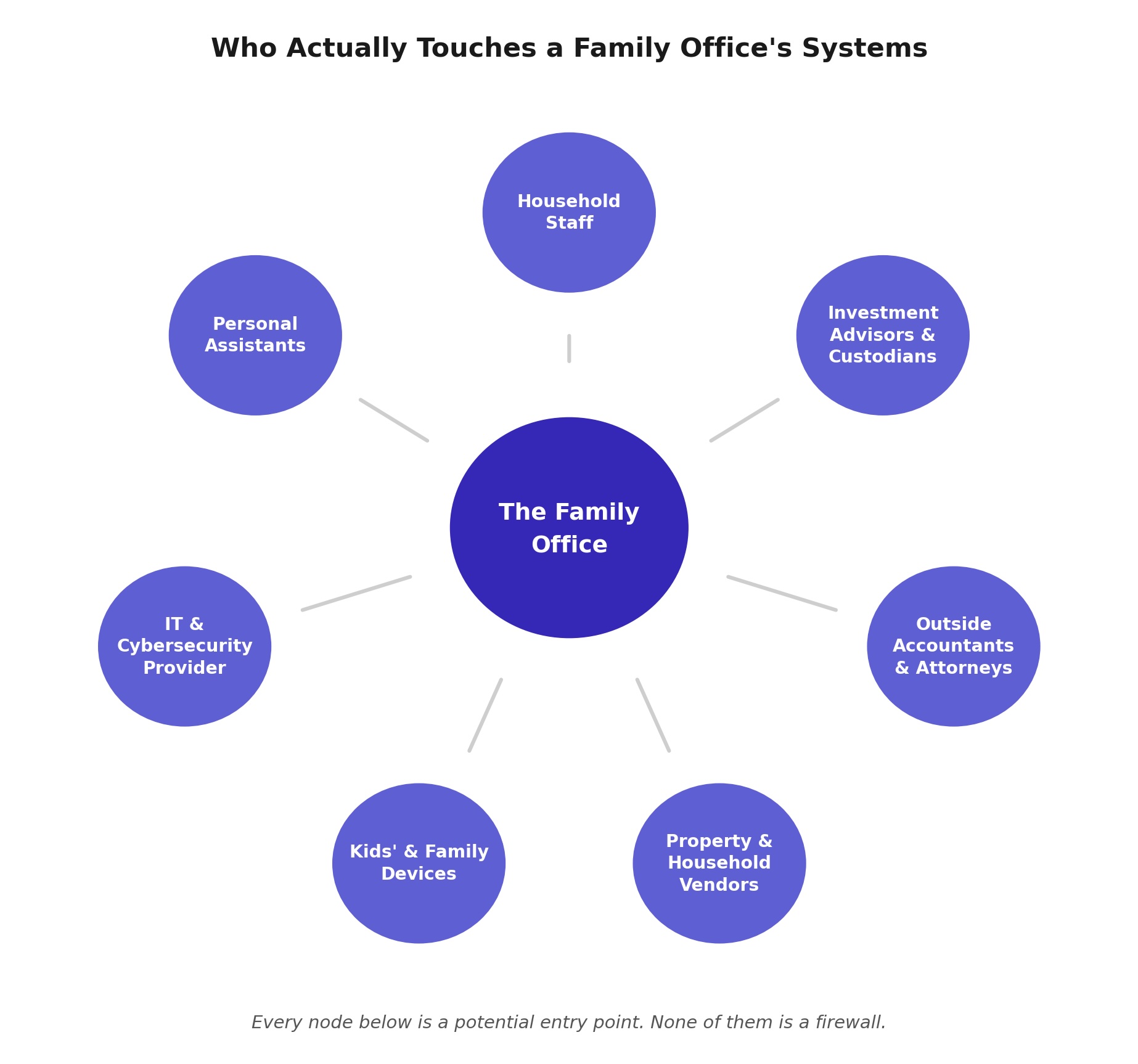
A firewall protects a network. It does nothing for the nanny's phone, the household manager's laptop, the property manager's vendor login, or a college freshman's gaming PC on the family Wi-Fi. A family office's real attack surface is every person and vendor who touches its systems, not a server rack, and most of them have never had a security conversation in their life.
Why This Hits NYC Family Offices First
New York City is home to one of the largest concentrations of private wealth in the world, and the family office channel nationally has grown roughly fivefold over the past decade as founders, executives, and private equity principals convert liquidity events into standing family offices. That density means more advisors, more vendors, more household staff, and more overlapping relationships in a smaller radius, which is exactly the kind of environment where a compromised vendor account or a spoofed advisor email travels fastest.
It also means NYC family offices are watched closely, by their peers and, increasingly, by people who would like to relieve them of some money. Discretion has always been the currency of this world. Cybersecurity, done well, is discretion applied to data instead of dinner conversation.
What Principals Want
Not one of the family office principals behind these numbers wants a lecture on encryption standards. What they want is closer to: who exactly can access our accounts, how quickly would we know if something looked wrong, and can our household staff be trained without being made to feel like suspects. That is a different conversation than the one most IT vendors are prepared to have, and it is probably why cybersecurity has become one of the most commonly added outsourced administrative functions among family offices over the past two years, ahead of bill pay, legal support, and human resources.
The family offices getting this right are the ones whose technology partner understands that a principal's actual priorities are privacy, trust, and continuity, and can translate a serious security program into that language instead of making the family sit through one built for a bank.
What a Proper Security Program Looks Like
In practice, this means a security program built around the people in that circle, not only the network in the basement: access reviews that cover advisors and vendors as carefully as employees, device management that extends to family members without turning a teenager's laptop into a corporate asset, and staff training written for a household manager or a personal assistant, not a compliance officer. It also means a vCIO-style advisory relationship that principals can understand, paired with a compliance-first technology approach that treats privacy as the whole point rather than a checkbox.
It also means resisting the urge to oversell the fear. Family offices are, by nature, allergic to drama. A technology partner who leads every conversation with worst-case scenarios will get the same polite nod as a salesperson, and then get quietly replaced. The ones who earn a long relationship with a family office lead with competence and discretion instead, and let the occasional plain-spoken warning carry more weight because it isn't background noise.
Start With People, Not Hardware
A firewall was never going to protect a family office on its own, and treating cybersecurity as a one-off hardware purchase is how offices end up among the majority Deloitte found still has real gaps in strategy. The stronger approach starts with the people in the circle around the family office, not only the equipment in the closet. We go deeper on what a right-sized program looks like in Family Office IT: Security Without Over-Engineering. If your family office has never had the version of this conversation that starts with people instead of hardware, let's have it.
About the Author
Team Techvera
Techvera Team
Articles written collaboratively by the Techvera team, combining expertise across cybersecurity, managed services, and digital transformation.