
Ask a family office principal why their technology has fallen behind and you will usually get a version of the same answer. We are too small to justify the spend.
The research disagrees. When Citi Private Bank asked family offices what was holding back their AI adoption in its May 2026 study, budget finished fifth. Lack of internal expertise finished first at 57%, more than double the 22% who named budget constraints. The scarce resource in most family offices is judgment about where the money goes, not the money.
One caveat before the reallocation argument, because it matters. Allocation only beats budget size once you are above a floor, and plenty of offices are still below it. Deloitte found that 34% of single family offices describe themselves as underinvested in operational technology, with another 38% only moderately invested. For roughly seven in ten offices, the honest answer is spend more and spend better.
Here is where the offices doing both are putting the money.
The Budget Is Not the Binding Constraint
Citi's barrier rankings are worth reading in order, because the order is the finding. Lack of internal expertise, 57%. Lack of awareness of what is available, 34%. Cybersecurity and privacy concerns, 28%. Uncertainty about return, 25%. Budget, 22%. Legacy system integration, 17%.
Four of the top five barriers describe a knowledge problem. A family office that cannot tell a mature product from a well-rehearsed demo, cannot say what a tool should return, and cannot evaluate a vendor's security posture will waste money at any budget level. Doubling the budget doubles the waste.
This is why the first dollar of a smarter allocation usually buys a person rather than a license.
Family Offices Will Fund AI. Far Fewer Will Run It.
The gap between how family offices invest and how they operate is wide enough to be funny.
The UBS Global Family Office Report 2026, covering 307 family offices with an average family net worth of USD 2.7 billion, found 65% already invested in the AI theme across data center infrastructure, software platforms and semiconductor producers. Citi found 22% using AI anywhere in their own operations, and that figure counts everything from automating a single task to running an investment forecast. They will fund the picks and shovels without picking one up.
By function the operating numbers get smaller. 16% use AI for investment performance reporting, 13% for portfolio construction, 10% for risk management, legal or compliance.
The restraint is defensible. Citi's respondents were direct that a tool which cannot guarantee data security does not get adopted, which is the right instinct for an operation holding a family's complete financial picture in one place. The offices that got past the block did not lower the bar. They built the governance that lets them clear it, then bought.
The Floor You Have to Clear First
Before allocation strategy means anything, the basics have to be in place. Most family offices are about halfway there.
Deloitte's Family Office Cybersecurity Report surveyed 354 single family offices with average assets under management of US$2.0 billion. Forty-three percent had been hit by a cyberattack in the previous 12 to 24 months. In North America the figure was 57%. For offices above US$1 billion in AUM it was 62%. A quarter had been attacked three or more times, and phishing accounted for 93% of the attacks reported.
Against that threat level, here is what those offices had in place. 85% use strong passwords and multi-factor authentication. 72% keep data backups. 58% train staff on security. Then it falls off. Half have no disaster recovery plan. 63% carry no cyber insurance. 68% have no know-your-vendor protocol. Only 34% have run a cybersecurity maturity assessment. 31% have no incident response plan at all, and another 43% say the plan they have needs work.
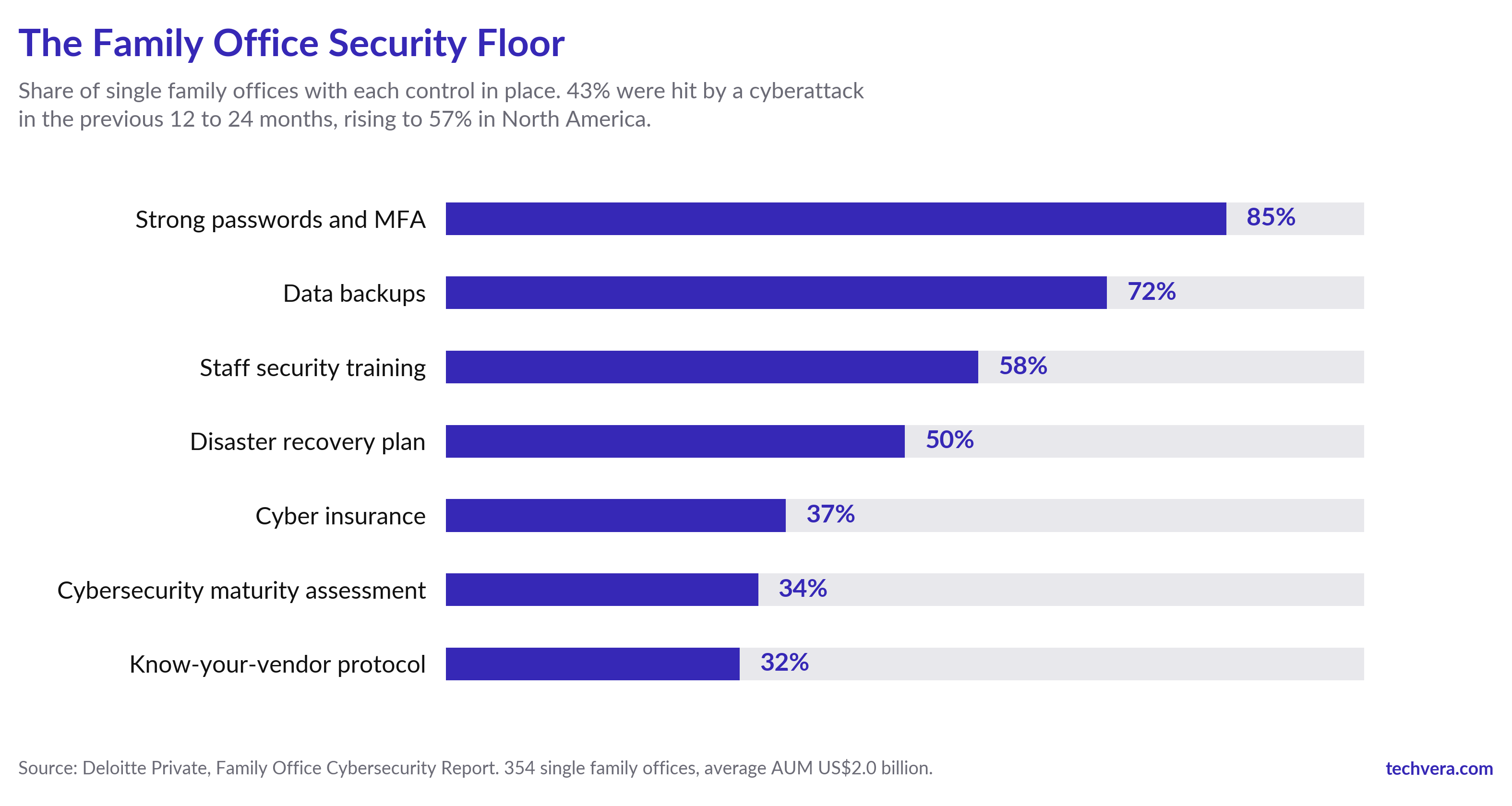
For a group of people who spend their working lives hedging risk, sitting uninsured at a 43% attack rate is a striking position.
That list is the floor. Multi-factor authentication, backups you have tested by restoring from them, a written incident response plan, disaster recovery, vendor due diligence, and an honest assessment of where you stand. None of it is expensive against a US$2 billion balance sheet. It is unglamorous, which is a different problem and often the real one. We covered the practical version of this in Family Office IT: Security Without Over-Engineering.
Where the Smarter Spenders Put Their Money
Above the floor, three allocation choices separate the offices getting value from the offices renewing subscriptions.
Expertise before tools. Citi's top barrier was internal expertise, and no software product fixes that. A CIO-level advisor who can evaluate a vendor, set a roadmap and say no to the wrong purchase returns more per dollar than another platform. For a lean office the role is almost always fractional, which is the entire argument in What Separates a Fiduciary-Grade IT Partner from a Generic MSP.
Identity before perimeter. Deloitte found 87% of family offices running cloud applications but only 61% with identity and access management in place. That is a 26-point gap between the offices that moved their data somewhere reachable from any device on earth and the offices that control who reaches it. Identity is the perimeter now, and it should be funded that way. The baseline is covered in Client Portal Security for Advisors: The MFA + SSO Baseline.
Vendors before software. More than two-thirds of family offices have no know-your-vendor protocol, while the average office is connected to custodians, accountants, legal counsel, investment managers, household staff platforms and a growing list of AI tools. Every one of those is a path in. A vendor review process costs staff time rather than license fees, which is exactly why it keeps getting skipped. The evaluation framework in Private-Equity Due Diligence: A Tech-Stack Evaluation Framework works just as well pointed at your own vendors.
Notice what these have in common. None is a product you can buy in a quarter and check off. All three are operating disciplines, which is why budget size predicts so little about who has them.
The Governance Line Rarely Budgeted For
Family offices run tighter governance on the money than on the office itself. UBS found 68% have formal financial performance measurement and 60% operate an investment committee, but fewer than half have implemented formal governance frameworks, only 35% have a defined succession plan for the family office, and 27% have a structured process for preparing heirs.
Technology governance sits in the same blind spot, and it is now the thing gating AI adoption. Before an ambient meeting tool, a document summarizer or a portfolio analysis model goes near family data, someone has to answer where the data goes, who can see it, how long it is retained, whether the vendor trains on it, and who is accountable when it goes wrong. Written down, reviewed, dated.
That document costs attention rather than money. Without it, the office defaults to the answer Citi's respondents gave, which is no. Our 90-Day Governance Plan for Any SMB Deploying an AI Agent is a workable starting structure.
Family offices also do not get a regulator to write this for them. Most single family offices fall outside SEC registration under the family office rule, so no examiner arrives with a checklist. The exposure does not leave with the examiner. State privacy laws still apply based on where principals, staff and beneficiaries actually live.
A Reallocation Test for Your Next Budget Cycle
Pull your current technology spend and sort every line into four buckets.
Software licenses and subscriptions
Security controls and infrastructure
Advisory, governance and expertise
Training
Most family offices find the first bucket holding the large majority and the third at or near zero. If that is your split, the fix is straightforward. Move money from bucket one to bucket three, and hold the total flat until someone qualified is deciding where it goes. The mechanics of building that budget are in Plan IT Like a Pro: How to Build a Smarter IT Security Budget in 2026.
Then ask three questions.
When did you last test a restore from backup? Not confirm the backup ran. Restore from it.
Who reviewed your last three vendor contracts for security terms, and what did they find?
If your primary systems went down at 9 a.m. Monday, what is the written procedure, and who has read it?
An office that answers all three cleanly is spending well at any budget. An office that cannot will not fix it by adding a line item.
Work With Techvera
Techvera works with family offices and financial services firms on this exact sequence: clear the security floor, then build the governance and advisory capacity that makes the rest of the budget worth spending. Our vCIO Services put a technology strategist in the room without adding headcount. Cybersecurity and Compliance Readiness cover the floor itself, and Managed AI covers the governance that has to exist before an AI tool touches family data.
Schedule a 30-minute strategy session.
Frequently Asked Questions About Family Office Budgeting
How Much Should a Family Office Spend on Technology?
Total budget matters less than allocation, provided the office already has basic security controls in place. Deloitte found 34% of single family offices describe themselves as underinvested in operational technology and 38% as only moderately invested, so most offices do need to spend more. The more useful test is whether the budget includes advisory and governance capacity rather than only software licenses. Citi Private Bank found that lack of internal expertise, not budget, is the top barrier to getting value from technology, cited by 57% of family offices against 22% naming budget constraints.
What Is the Biggest Barrier to AI Adoption in Family Offices?
Lack of internal expertise, cited by 57% of family offices in Citi Private Bank's May 2026 research. Lack of awareness of available options ranked second at 34%, and cybersecurity or privacy concerns third at 28%. Budget constraints ranked fifth at 22%. Family offices generally will not adopt an AI tool that cannot guarantee data security, so vendor vetting and a written governance policy usually have to come before deployment rather than after it.
Do Family Offices Need a Cybersecurity Program If They Have No Regulator?
Yes. Most single family offices fall outside SEC registration under the family office rule, so no regulator prescribes a cybersecurity program, but the risk is unchanged. Deloitte found 43% of single family offices experienced a cyberattack in the previous 12 to 24 months, rising to 57% in North America and 62% for offices managing more than US$1 billion. State privacy laws also apply based on where principals, staff and beneficiaries live, regardless of federal registration status, and 63% of family offices carry no cyber insurance to absorb the cost when something goes wrong.
About the Author
Team Techvera
Techvera Team
Articles written collaboratively by the Techvera team, combining expertise across cybersecurity, managed services, and digital transformation.