
Business email compromise cost victims nearly $3.05 billion in 2025, the second-largest loss category in the FBI’s annual Internet Crime Report. Only investment fraud took more. The scam is also routine. Seventy-four percent of organizations were affected by it in 2025, according to the Association for Financial Professionals’ survey of 465 treasury practitioners.
The FBI defines business email compromise as a scam aimed at businesses that regularly send wire transfers, carried out through social engineering or account intrusion. Your firewall gets no vote when the CFO asks an employee for a favor. The outcome depends on what that employee has practiced, and FINRA lists tabletop exercises among its effective cybersecurity practices.
This wire fraud tabletop exercise takes five minutes of a Monday meeting. It has five rounds, one scoring sheet, and no slides. Allow ten more minutes afterward, because someone will want to argue about Round 3.
If you run IT at a financial services firm, you probably do not release wires. This drill shows you what the people in operations and finance would do, before an attacker runs the same test unannounced.
The $25 Million Meeting Where Nobody Else Was Real
The script is modeled on a real case. In January 2024, a finance employee in the Hong Kong office of Arup, the British engineering firm, received a message that appeared to come from the company’s UK-based chief financial officer about a confidential transaction. He suspected phishing. Then he joined a video call where the CFO and several colleagues looked and sounded right, and he set his doubts aside. Hong Kong police said every other person on the call was a deepfake, and the fraud surfaced only when he later checked with head office.
Over about a week he made 15 transfers to five bank accounts, totaling HK$200 million, or roughly $25.6 million. Arup confirmed it was the victim that May and said none of its internal systems were compromised. Its chief information officer, Rob Greig, later told the World Economic Forum the incident was “technology-enhanced social engineering” and that he had since built a deepfake of himself in about 45 minutes with open-source software.
Nothing in that sequence depended on Arup being an engineering firm. The attackers needed one employee with payment authority, and every RIA, broker-dealer, and family office has those. It is the borrowed trust we described in The Biggest Heist in History Didn’t Need a Getaway Car.
Keep the deepfake in proportion. BEC complaints that referenced AI accounted for a little over $30 million of 2025 losses, about 1 percent of the category, though the FBI cautions that many victims are unaware of how much AI was involved. Its definition of BEC already covers channels beyond email, including virtual meeting applications. So the drill scores process. A callback to a number on file and a second approver apply whether the request arrives as a plain email or with a full supporting cast.
How to Run It in Five Minutes
Gather everyone who can request, approve, or release a payment, plus whoever answers the help desk line. Print one scoring sheet per person and bring a timer. Then follow three rules.
Each round gets 60 seconds, including the time it takes you to read it aloud.
Answers go on paper, in silence. Open discussion lets the most senior voice answer for everyone, and you are here to learn what each person would do alone.
Nobody scores anything until Round 5 ends.
Set the scene in one line before you start the timer. Everyone in the room works in operations at your firm, and it is an ordinary Monday.
Five Rounds With a Fake CFO
Round 1. The email. Monday, 9:12 a.m. An email arrives from the CFO, who is out of the office today. She is closing a confidential acquisition and needs you to handle several payments this week. She asks you to keep it between the two of you for now. What do you do before you reply?
Round 2. The video call. You hesitate. Ten minutes later a meeting invite arrives. The CFO, the controller, and outside counsel are on the call with cameras on. They look right, they sound right, and they answer your questions. What has this call verified?
Round 3. The instructions. The CFO needs 15 wires sent to five beneficiaries the firm has never paid, spread across the week. The details arrive by email after the call. Who besides you must approve a wire to a new beneficiary, and can the CFO waive that step?
Round 4. The pressure. Wednesday. The CFO messages you. The deal closes Friday, the board is watching, and bringing in anyone else would breach confidentiality. She thanks you for your discretion. Who do you tell anyway?
Round 5. The discovery. Friday, 4:40 p.m. You pass the real CFO in the hallway and mention the acquisition. She has never heard of it. The wires are gone. Who do you call in the next ten minutes, and where is that number written down?
The Scoring Sheet
Each person scores their own sheet. The maximum score is 10.
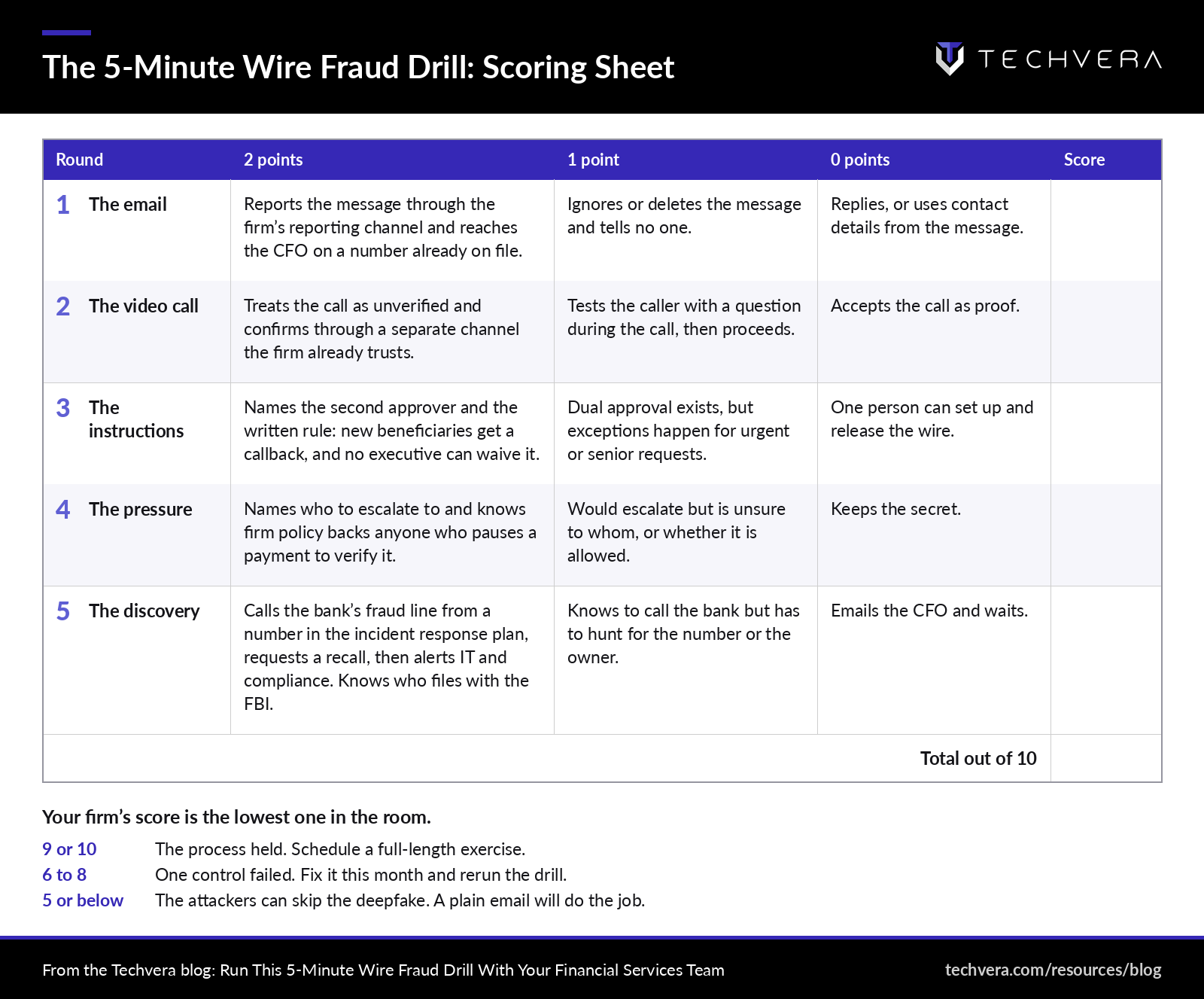
What Each Missed Point Tells IT
Every round maps to a control you own or can influence.
Round 1 tests the reporting channel. If nobody reported the email, find out whether staff know the channel exists and whether anyone watches the queue. FINRA’s effective practices include training staff to spot and report phishing and social engineering.
Round 2 tests verification outside the attacker’s channel. That takes a directory of callback numbers stored somewhere other than the mailbox the request came from. The New York State Department of Financial Services says training should cover verifying a requester’s identity when an unexpected transfer request arrives by phone, video, or email, and its letter cites the Hong Kong case.
Round 3 tests the bank portal. A written policy can require two approvers while the portal’s entitlements let one user create a beneficiary and release the wire. Check the entitlements. We covered the closing-table version of this problem in Wire Fraud in Title and Settlement.
Round 4 tests permission. Software cannot fix this one. Put the rule in writing: anyone may pause any payment to verify it, and nobody is penalized for the delay.
Round 5 tests the incident response plan. The FBI’s guidance is to contact the bank immediately, request a recall, and file a complaint at ic3.gov with the full transaction details. In 2025 its Recovery Asset Team froze $679 million of $1.16 billion in attempted theft across 3,900 incidents, a 58 percent success rate. IT’s next job is to find out whether a mailbox was compromised. If one was, you may also have a customer information incident, which brings in your regulators. Greig’s lessons from Arup include rehearsing the response so everyone knows their role.
What the Drill Does Not Do for Compliance
A five-minute drill is practice. It does not satisfy any regulator’s testing requirement and should not be filed as if it does.
NYDFS. Part 500 requires covered entities to give all personnel cybersecurity awareness training that includes social engineering at least annually, and to test the incident response plan at least annually with all staff and management critical to the response. The drill supports the training requirement. It does not replace the plan test. Our overview of the Part 500 amendments covers the rest.
SEC. The Division of Examinations’ fiscal year 2027 priorities say examiners will evaluate incident response procedures under amended Regulation S-P, including customer notification and oversight of service providers. The document names “synthetic or deepfake voice and video used for social engineering” among the threats examiners will look at, and it focuses Regulation S-ID reviews on account takeovers and fraudulent transfers. For the policy work, see what every RIA must update for Reg S-P.
FINRA. The 2026 Annual Regulatory Oversight Report describes impersonation schemes that begin with a hacked or look-alike email address and end in a third-party wire request, along with GenAI-enabled fraud that includes deepfake audio and video. Its effective practices include tabletop exercises with stakeholders. Our working guide to FINRA cybersecurity requirements goes deeper.
Date the completed scoring sheets and keep them with your training records. When the lowest score reaches 9, move to a full exercise. CISA publishes more than 100 tabletop exercise packages with scenarios, discussion questions, and an after-action report template.
Run It Monday
If the lowest score in the room is under 9, you know which control to fix first. Techvera works with financial services firms on those fixes through Cybersecurity and Compliance Readiness, from security awareness training and incident response to gap assessments, policy development, and audit preparation. For the questions to put to whoever runs your IT, read 5 Cybersecurity Questions to Ask Your IT Provider Before Your Regulator Asks You.
Bring the scoring sheets to a conversation with us. Connect with our team for a free 30-minute session with no obligation. If SOC 2 or PCI-DSS is also on your list, the Compliance Readiness Checker assesses your readiness in minutes.
Frequently Asked Questions
What is a wire fraud tabletop exercise?
A wire fraud tabletop exercise is a guided walk-through of a fake payment request that tests how staff verify, approve, escalate, and respond before real money is at risk. A short version can run in five minutes with five timed rounds and a written scoring sheet. FINRA’s 2026 Annual Regulatory Oversight Report lists tabletop exercises with stakeholders among its effective cybersecurity practices, and NYDFS Part 500 requires covered entities to test their incident response plans at least annually.
How should a finance team verify a wire request from an executive?
Verify it through a channel the requester does not control. Call the executive on a number already on file, require a second approver for any new beneficiary, and let no executive waive either step. A video call does not count as verification. In the 2024 Arup case, an employee sent about $25.6 million after a video call in which every other participant was a deepfake. NYDFS guidance says training should cover verifying a requester’s identity when an unexpected transfer request arrives by phone, video, or email.
What should you do in the first hour after a fraudulent wire transfer?
Call your bank’s fraud line and request a recall of the funds, then file a complaint at ic3.gov with the full transaction details. That is the FBI’s guidance regardless of the amount lost. In 2025 the FBI’s Recovery Asset Team froze $679 million of the $1.16 billion in attempted theft it acted on, a 58 percent success rate. Next, have IT determine whether an email account was compromised, and have compliance review notification duties under rules such as SEC Regulation S-P and NYDFS Part 500.
About the Author
Team Techvera
Techvera Team
Articles written collaboratively by the Techvera team, combining expertise across cybersecurity, managed services, and digital transformation.