
For years, Regulation S-P was the rule everyone at a registered investment adviser nodded along to and few actually operationalized. Write a privacy notice, file it, move on. That era is over. The SEC's 2024 amendments converted a set of implicit expectations into explicit, dated obligations, and the compliance deadlines are no longer somewhere off in the future. They are here.
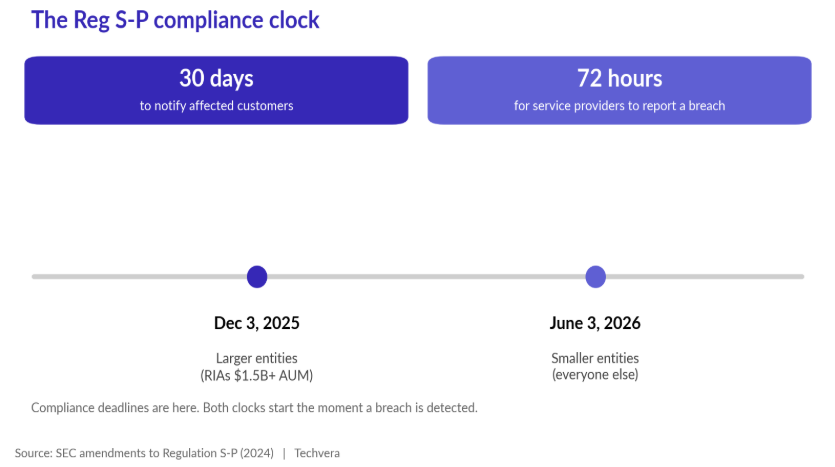
The SEC adopted the amendments on May 16, 2024. Larger entities, which for investment advisers means firms with $1.5 billion or more in regulatory assets under management, were required to comply by December 3, 2025. Smaller entities had until June 3, 2026. The good news is that the work is concrete. It comes down to a handful of documents that either exist and hold up, or do not.
We covered the full background of the rule in our overview of what the 2024 Reg S-P amendments mean for your IT. This post is the follow-up your compliance officer actually needs: the specific documents to update before an examiner opens the binder.
Document 1: An Incident Response Program That Names Names
The amendments require covered institutions to adopt a written incident response program, and the operative word is program, not plan. A one-page document stating that the firm will respond to incidents appropriately is unlikely to survive contact with an examiner. The program has to describe how you detect unauthorized access to customer information, how you contain it, how you recover, and who is responsible at each step. If your current plan does not name a role for every action, it is a policy, not a program. Rewrite it so that a new hire could follow it at 2 a.m. during an actual incident, because that is precisely when someone will have to.
Document 2: The 30-day Customer Notification Workflow
This is the part with teeth. Under the amendments, you must notify affected individuals within 30 days of determining that unauthorized access to or use of sensitive customer information has occurred or is reasonably likely to have occurred. The rule permits a reasonable investigation within that window, but the clock does not wait for you to feel ready. Your IT policy needs a documented workflow that specifies how a determination is made, who makes it, and how notifications go out, so that the 30 days is a process you run rather than a panic you improvise. For firms juggling overlapping obligations, our guide to business continuity planning for RIAs shows how notification fits into a broader response posture.
Document 3: Service Provider Oversight and the 72-hour Clock
Most RIAs run on outsourced technology, and Reg S-P now makes your vendors' security your documented responsibility. You are required to take reasonable measures to ensure that service providers with access to customer information notify you as soon as possible, and no later than 72 hours after becoming aware of a breach on their systems. In practice, that means your vendor agreements and due diligence files have to change. A handshake and a logo on your website will not cut it. Every provider that touches client data needs a contractual notification commitment and a due diligence record behind it.
Document 4: Records That Prove You Did the Work
The amendments also expand recordkeeping. It is not enough to have a program, a notification workflow, and vendor oversight. You have to be able to prove they exist and that you follow them. Examiners increasingly want an evidence file, not just a binder of policies. That distinction is the theme running through the SEC's 2026 examination priorities, which name cybersecurity and Reg S-P explicitly. The firms that struggle are not usually the ones without policies. They are the ones who cannot demonstrate the policy was ever operational.
A CISO-level Problem at a Firm That Has No CISO
Here is the uncomfortable part. The questions Reg S-P now forces are the kind a chief information security officer answers, and most RIAs cannot justify a full-time hire at that level. That gap is exactly why a growing number of firms are bringing in fractional security leadership before a full-time IT director. A vCIO can own the incident response program, run vendor due diligence, and stand in front of an examiner, at a fraction of the cost of the salary. If you want the full budget picture, we broke it down in what it actually costs to run a compliant RIA technology stack in 2026. And if a password and good intentions still protect your client portal, start with our MFA and SSO baseline for advisor portals.
The Takeaway
Reg S-P compliance is no longer a document you file. It is a program you operate, on a clock that starts the moment a breach is detected. All firms, regardless of size, are accountable.
Techvera helps financial services firms build examiner-ready IT programs, from compliance readiness to vCIO leadership. If you are not certain your incident response program would survive a Tuesday-morning exam, schedule a strategy session. No obligation, 30 minutes, and we will bring the checklist.
About the Author
Team Techvera
Techvera Team
Articles written collaboratively by the Techvera team, combining expertise across cybersecurity, managed services, and digital transformation.