
An urgent care clinic can see more patients before lunch than a specialty practice sees in a week. That throughput is the entire business model. It is also the reason HIPAA gets harder the busier you get. Every patient who walks in is a disclosure event, a consent workflow, and a record that has to move between systems, and sometimes between locations. The controls that work fine for a quiet family practice tend to fail quietly at volume, right up until the moment they fail loudly.
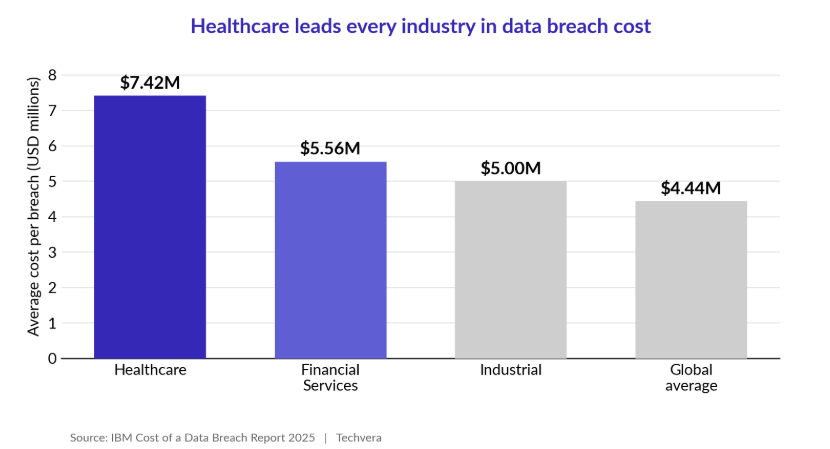
The financial stakes are not abstract. Healthcare has been the most expensive industry for a data breach for fourteen consecutive years, with an average cost of $7.42 million in 2025, according to IBM's Cost of a Data Breach Report. Healthcare breaches also take the longest to contain, at 279 days on average. In 2024, 725 large healthcare breaches exposed more than 275 million records, roughly 82 percent of the U.S. population, and hacking accounted for 81 percent of those incidents. For a walk-in clinic the logic is simple: the more patients you move, the more protected health information you touch, and the more surface area you hand to an attacker or an auditor.
The Waiting Room is Your Loudest Compliance Risk
Walk into any busy clinic and you will hear the compliance risk before you see it. Names called across a full room. A front-desk conversation about a copay that everyone in line can follow. A sign-in sheet passed hand to hand. None of this is automatically a violation, and this is where a lot of well-meaning practices overcorrect into workflows that slow the line without adding real protection.
HIPAA does not require a cone of silence at the front desk. The Privacy Rule explicitly permits incidental disclosures that occur as a byproduct of an otherwise permitted activity, as long as you have reasonable safeguards in place and you apply the minimum necessary standard. Calling a patient by name to bring them back is fine. So is a sign-in sheet, provided it captures only what is strictly needed, typically a name and an arrival time, and not the reason for the visit, symptoms, or insurance details. The Rule does not ask you to eliminate every possible overheard word. It asks you to be reasonable, and to be able to show that you were.
Speed at Intake Should Not Mean Shortcuts in The Tech Stack
Where high-volume clinics get into trouble is the technology underneath the front desk, not the front desk itself. Digital intake tablets that are never wiped between patients. A shared workstation logged in under one clinician's credentials all day because logging in and out forty times is annoying. A tablet that autofills the previous patient's information. These are the accommodations busy teams make to keep the line moving, and each one erodes a specific HIPAA technical safeguard.
The Security Rule spells out what is required here, from unique user identification and automatic logoff to audit controls and encryption. We broke all of them down in our guide to the 18 HIPAA technical safeguards every practice must implement. The takeaway for a walk-in environment is that the safeguards have to be designed for speed, not bolted on in a way that punishes it. If compliance makes the fast path harder than the noncompliant path, staff will find the noncompliant path every time.
The Same Patient, Three Locations, One Liability
Most urgent care and integrated health operators do not run one site. They run three, or seven, and the same patient might be treated at any of them. That convenience depends on records flowing between locations, which means your HIPAA exposure is now a network problem as much as a policy one. If guest WiFi in the lobby touches the same flat network as your clinical systems, one compromised phone in the waiting room becomes a path to PHI.
The fix is proper network segmentation across sites, so clinical traffic, administrative traffic, and guest access never share a lane. It is also uptime. When systems go down in a walk-in setting, patients do not wait, they leave, as we covered in why urgent cares cannot rely on basic IT. Availability is one of the three pillars HIPAA cares about, alongside confidentiality and integrity. A clinic that cannot access its own records during an outage has a compliance problem and a revenue problem in the same breath.
Where Clinics Actually Get Caught
When the Office for Civil Rights investigates a breach, the most common finding is not a dramatic hack. It is a missing or inadequate risk analysis. Year after year, OCR enforcement comes back to the same root cause: the practice never formally assessed where its PHI lived, how it moved, and where it was exposed. A high-volume clinic has more of all three, which makes the analysis more important and the gap more expensive when it is skipped.
If you want to see what that gap costs in dollars rather than abstractions, we itemized it in the true cost of a HIPAA breach for a small practice. And with OCR sharpening its focus on specialty and high-throughput practices, it is worth reading our 2026 HIPAA audit outlook to understand what documentation an examiner will actually ask to see.
What To Do Before Your Next Busy Monday
High-volume care and airtight HIPAA are not in conflict. They just require technology that was designed for the pace you actually run at. Start with a current risk analysis, segment your network so the lobby cannot reach the chart, build technical safeguards that make the compliant path the fast path, and pressure-test your vendors, because their access is your liability too, as we explain in our breakdown of business associate agreements and vendor risk.
Techvera builds and manages IT for healthcare practices that cannot afford to choose between speed and compliance, backed by our cybersecurity and compliance readiness programs. If your busiest hour is also your least protected one, schedule a strategy session. No obligation, 30 minutes, and no cone of silence required.
About the Author
Team Techvera
Techvera Team
Articles written collaboratively by the Techvera team, combining expertise across cybersecurity, managed services, and digital transformation.